Powered By Blogger

Search This Blog

Wednesday, June 27, 2012

ONE CITY Transit Plan Proposal: Dramatic OneCity proposal floated by Stintz, DeBaeremaeker

Two councillors leading the TTC say it’s time to move ahead on an accumulating wish list of transit projects: 175 kilometres, including six subway lines, 10 LRTs and five bus and streetcar routes across the city.
The latest proposal would dramatically expand Toronto’s transit network over the next 30 years. And while it comes with a $30 billion price tag, it is well within the city’s grasp, say the councillors at the helm of the Toronto Transit Commission.

James: Will Toronto pay for subways?
TTC chair Karen Stintz (Eglinton-Lawrence) and vice-chair Glenn De Baeremaeker (Scarborough Centre) believe residents can be persuaded to make the kind of transformative investment that would save Toronto from descending into a prosperity-crushing, gridlocked future.
They are calling their proposal OneCity and are asking council to approve a staff study of the plan in July. Councillors would then have until October to take the plan to their constituents before considering approval.
“What this does is it clarifies for the city of Toronto what our network is, how it fits into the regional context and how we propose to fund it,” Stintz said. “The funding, if approved, is dedicated, dependable and debt-free.”
If it flies, Stintz, who has denied she plans to run for mayor, will have engineered the delivery of two elements in Mayor Rob Ford’s election platform: A Sheppard West subway extension linking the Yonge line with the Spadina subway, and the extension of the Bloor-Danforth subway along the Scarborough Rapid Transit (SRT) route.

More: TTC reports $22 million surplus due to ridership growth last year
The timeline is critical, say the councillors, because the provincial cabinet has not yet signed off on converting the SRT to light rail transit and the new plan depends on being able to leverage the upcoming property reassessment process that begins in the fall.
“If we can create this value proposition and if we can get buy-in from council and if the public believes this is a viable plan, we are in a better position to start collecting that revenue in 2013,” Stintz said.
The funding proposal would involve getting the province to approve a regulatory change that would allow the city to capture 40 per cent of the higher property values from next year’s reassessment.
That would amount to $45 per average household annually, accumulating to $180 a year on average, which would remain on property tax bills. It would mean $272 million a year in new tax revenue for the city.
“Every penny will go into building and maintaining public transit. That’s going to be the test for council and the people of Toronto,” said De Baeremaeker.
Toronto’s property taxes would still be among the lowest in the region, Stintz said.
The $272 million would form the city’s third of an annual $1 billion transit investment, with the province and Ottawa kicking in a standard one-third each.
The plan is being proposed as the provincial agency Metrolinx rallies support for a regional transit investment strategy to raise about $40 billion. That’s the cost of implementing the rest of the Big Move regional transit plan.
The province has already committed to the first $11 billion of that plan, including $8.4 billion for four lines in Toronto: LRT on Finch, Sheppard and Eglinton, and the conversion of the SRT into LRT extending from the Eglinton line.
Queen’s Park gave Metrolinx until June 2013 to figure out how to raise the rest of the money. But with the Liberals in a minority government and close to the next election by the time the strategy is published, there are fears no party will be willing to commit to new taxes.
Stintz has said repeatedly that Metrolinx needs to be consulting municipalities on the issue of how to raise transit funds. Other politicians, including Mississauga Mayor Hazel McCallion, are also advocating new taxes and tools to pay for transportation.
The first funds from the Stintz-De Baeremaeker plan would go toward converting the SRT route into a subway line, at a cost of about $2.3 billion. The project would have a head start from the $1.8 billion the province has already committed, Stintz said.
Although a subway would be routed somewhat differently from the SRT, it would have the advantage of not shutting down the SRT for four years — unlike the current plan, which calls for putting SRT riders on buses for that period, while the new LRT is built.
De Baeremaeker says he’s confident the six Scarborough-area MPPs would support the idea.
The second priority in the new OneCity vision would be an east waterfront LRT, at a cost of about $300 million. Waterfront Toronto has allocated $90 million toward transit on the lakefront east of Yonge St., and developers there have been bracing for a temporary transit solution such as bus rapid transit.
All the lines in the OneCity plan have been approved at one time or another, and in some cases the environmental assessments have been done for years, said De Baeremaker.
Stintz said she’s had preliminary discussions with the province and the mayor’s staff about the plan, but no commitment of support.
OneCity rebrands some potentially divisive projects such as a downtown relief subway line, which has been renamed the “Don Mills Express” line.
It also aligns with some regional transit projects, including the air-rail link, which the councillors say could be converted to public transit by adding three more stops. A second set of tracks to GO’s Stouffville line would allow for a Scarborough Express above-ground subway or train that delivers riders from Steeles Ave. to Union Station.
OneCity's proposed lines
  Six subway lines, 72 km, $18 billion
Replace the Scarborough RT with a subway from Kennedy Station to Sheppard and McCowan; extend the Yonge subway to Steeles Ave.; build a Sheppard West subway to Downsview Station; build a Don Mills Express subway line from Eglinton to Queen St.; upgrade the Bloor-Yonge subway station; build a Scarborough Express line from Steeles Ave. to Union Station; build an Etobicoke Express Line from the airport to Union Station using the air-rail link.
  10 LRTs, 73.5 km, $9.5 billion
Extension of the Sheppard East line to Meadowvale, the zoo, and Malvern; build a Scarborough Malvern LRT; extend the Eglinton LRT to the airport; extend the Finch West LRT to Humber College and the airport; build a Jane LRT from Steeles to Bloor; Waterfront West LRT from Union Station to Long Branch; a Finch West LRT from Keele to Yonge St. and a Don Mills LRT from Steeles to Eglinton
  Five bus and streetcar lines, 25.7 km, $1.2 billion
Waterfront East streetcar line from Union Station to Parliament St., Ellesmere bus rapid transit from Scarborough Centre to Sheppard and Kingston Rd.; Kingston BRT from Victoria Park Station to Eglinton and Kingston Rd.; extend the St. Clair streetcar from Keele to Jane; a Wilson BRT from Wilson Station to Keele St.

Top Stories on the Internet:

Body removed from rubble of collapsed Elliot Lake mall, search on for survivors

Ministry of Labour inspected mall six times before collapse

‘Ovenlike’ conditions on their way to Southern Ontario

Tim Hudak urges sweeping changes to strip unions of power, help business create jobs

Circumcision of young boys banned by German court

MEXICAN PRESIDENTIAL ELECTION: Online and on the streets, Mexico youth protests grow as election looms; Mexican election could mean drug war strategy shift, U.S. officials say


Wed June 27, 2012

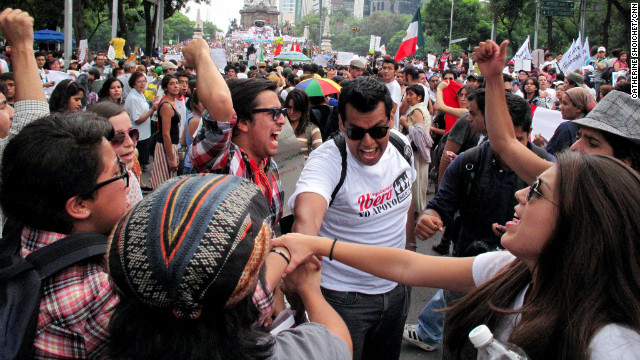
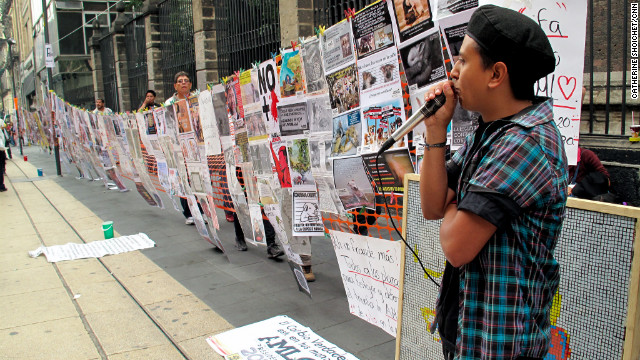
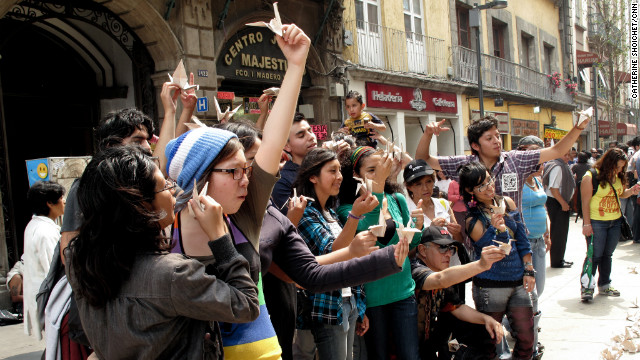
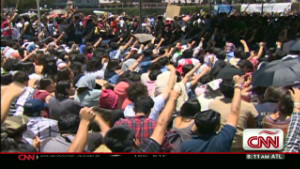
Students from the Iberoamerican University chant a school cheer during a protest last weekend in Mexico City. A video they uploaded to YouTube helped launch a nationwide youth protest movement. The demonstrators have added fuel to the political frenzy leading up to Mexico's elections on Sunday, July 1. Students from the Iberoamerican University chant a school cheer during a protest last weekend in Mexico City. A video they uploaded to YouTube helped launch a nationwide youth protest movement. The demonstrators have added fuel to the political frenzy leading up to Mexico's elections on Sunday, July 1.
HIDE CAPTION
Mexico's student movement
Mexico student movement
Mexico's student movement
Mexico youth protest
Mexico's youth speak out
Mexico's student movement
<<
<
1
2
3
4
5
6
7
8
9
>
>>

STORY HIGHLIGHTS
  • Mexican youth movement adding fuel to frenzy leading up to Sunday presidential vote
  • About a third of Mexico's 79.4 million registered voters are between 18-29
  • Unemployment rate of those 15-24 is nearly 10%, double the national average
  • Officials estimate that millions of young Mexicans, known as "ninis," neither study nor work
Mexico City-- They sport purple hair and piercings, plaid shirts and plastic aviator glasses. A guy with dreadlocks totes a bongo drum.
Five weeks ago, they were scrambling to finish homework assignments and studying for exams at Mexico City's Iberoamerican University. Before then, many of them had never met.
Now, the students huddle in a tight circle at a weekend protest, stack their hands in the middle and belt out a school cheer: Wolves, howling, on the path to truth. Ow-ooo. Ow-ooo. Ow-ooo.
They have become high-profile protagonists in a swelling youth movement that has drawn attention from the nation's presidential candidates and added fuel to the political frenzy leading up to Sunday's vote.
They protest by day and plan by night, using social media as a key weapon in their offensive.

Mexico protesters rally ahead of vote

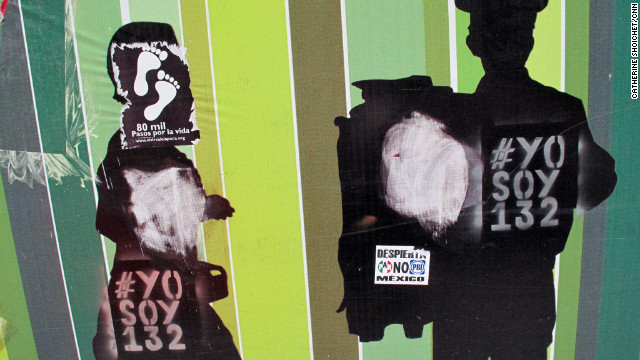
#yosoy132

La fuerza del cambio

#yosoy132
A video they made has garnered more than 1.1 million views on YouTube. Three of four candidates squared off in an online presidential debate they helped organize. Thousands of youth across the country are wearing T-shirts and waving signs that support them.
"It's like a storm, getting stronger," says Luis Sosa, a 25-year-old graduate student who marched in Sunday's protest in the nation's capital. "It's the first time in a long time that young people have raised their voice."
Mexico's 'lost generation'
By the numbers, the picture for Mexico's young people is bleak.
Analysts point to them as the most common casualties in a brutal drug war that has claimed more than 47,500 lives in fewer than six years.
And the unemployment rate of those aged 15 to 24 is nearly 10%, double the national figure.
"Being young, poor and living in the wrong place adds up to a death sentence," academic Alberto Aziz wrote in a 2010 column for Mexico's El Universal newspaper.
Officials estimate that millions of young Mexicans neither study nor work. They are known the ninis -- Spanish for neither, nor. Some have called them Mexico's "lost generation."
"Many young people, when they finish middle school, they are left for years with no direction," says Norma Escobar, strategy recruitment director at the Manpower employment agency in Mexico City.
The problem is so prevalent that government-sponsored youth addiction centers across the country offer brightly colored brochures for ninis alongside handouts that warn against smoking, alcohol and drugs.
"If they ask you, 'do you work or do you study?' and you cannot answer, this information is for you," the brochure's cover says.
"Between 7 and 9 million youth like you neither study nor work," the brochure says, advising readers to try different activities like playing sports, volunteering or learning a language.
More than 100 government-sponsored Juvenile Integration Centers across the country have programs aimed at keeping ninis off the streets.
"Our goal is to keep them from falling into the world of drugs," says Juan Ramiro Vazquez Torres, a regional coordinator based in Mexico City.
If they don't, the consequences can be dire.
Last year, a judge sentenced a 14-year-old boy to three years in a correctional facility after he was found guilty of torturing and beheading at least four people while working for the South Pacific drug cartel.
Mexican youth are "the most affected not just by unemployment, but also by the lack of health care coverage, discrimination, violence and the fight against organized crime," according to a study released in April by Metropolitan Autonomous University sociology professor Enrique Cuna Perez.
Those same factors discourage young people from believing in the country's democracy, he says.
About a third of Mexico's 79.4 million registered voters are between the ages of 18 and 29.
According to Cuna's study, 75% of young Mexicans surveyed said they weren't planning to vote in this year's presidential elections.
'Like trying to put out a fire with gasoline'
Young faces flash by in the video, one by one.
Bunk beds and pink wallpaper and photo collages appear behind them.
They say their names and hold their school IDs and repeat, "We are students from the Ibero."
Days earlier, they booed and chanted "get out" when presidential candidate Enrique Peña Nieto visited the Iberoamerican University.
Officials from Peña Nieto's campaign quickly dismissed the May 11 protest, saying the outbursts were not from students but from outsiders dragged there by political operatives to cause commotion. As he rushed out to a waiting car, the candidate told CNNMexico he did not believe that the protesters were genuine.
"That," says 22-year-old communications student Federico Gomez, "was like trying to put out a fire with gasoline."
Three days later, the students fired back on social media, promoting a video on YouTube titled "131 students from the Ibero respond."
The day the video went up, it became a trending topic on Twitter, says Rodrigo Serrano, one of the students who helped edit it. In 24 hours, it was viewed half a million times.
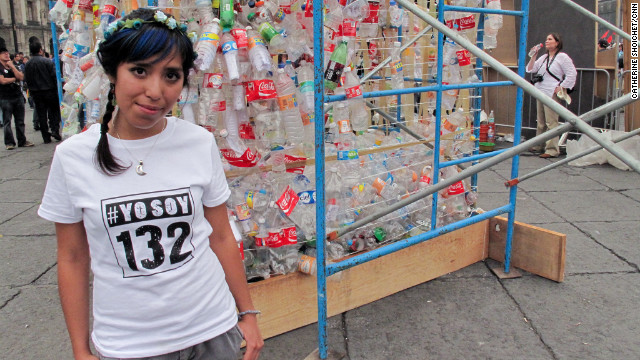
Students at other universities quickly showed their solidarity, posting links to the video on Twitter and Facebook with the hashtag #YoSoy132 (I am 132).
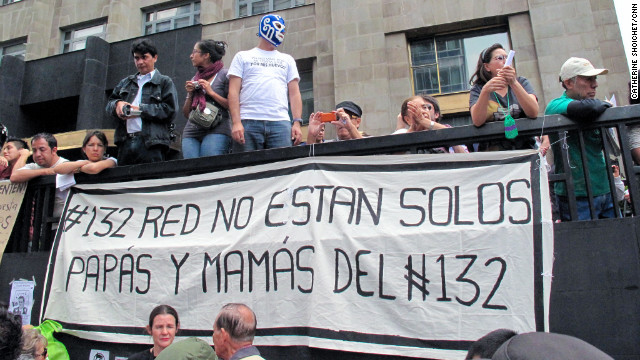
That small catchphrase became the name for something much larger. What started with 131 students at one school in Mexico City has expanded into a political movement that includes more than 100 universities throughout the country.
#YoSoy132 has committees and meetings, strategies and spokesmen.
Its activism moves fluidly from social media to the streets, with tens of thousands of students marching in numerous demonstrations in Mexico's capital and throughout the nation.
Support for the movement extends beyond Mexico's borders. A post on an Occupy Wall Street website last month called on supporters of the U.S.-based movement to "express solidarity with the Mexican Spring."
Students from the Ibero say they hoped to draw attention to their cause but never expected the group to grow so large or so fast.
"I never thought I'd see something like this in my generation," says Sosa, the grad student.
He notes there are parallels -- but also significant differences -- between the Mexican youth protests and the so-called Arab Spring demonstrations that toppled governments in the Middle East.
"We are not clamoring for democracy like they are," he says. "We are defending our democracy."
Sosa and other participants in the movement say #YoSoy132 has no political affiliation but opposes the candidacy of Peña Nieto, whose Institutional Revolutionary Party ruled Mexico for more than 70 years until it was ousted in 2000 elections.
They also criticize Mexican networks Televisa and TV Azteca, which control more than 90% of the market in a country where the vast majority of people still get their news and information through broadcast television.
Protesters say Televisa and TV Azteca have showered Peña Nieto's campaign with favorable coverage. The broadcasters deny it, saying each candidate has been given equal time.
Sharp rebukes of the student movement have continued to come from Peña Nieto's campaign and supporters, who accuse the students of being partisan, disingenuous and disrespectful.
When #YoSoy132 hosted an online presidential debate this month, Peña Nieto sent a letter declining the movement's invitation to attend, saying, "the group's political position against me and my proposals ... does not guarantee the space of neutrality that is required to conduct a debate in conditions of equality."
But the other three candidates attended, with the surge in youth activism drawing attention from both ends of the political spectrum.
Josefina Vázquez Mota of the conservative ruling National Action Party has pledged to make young people an integral part of her government.
"I am not going to consult with young people," she told a separate online town hall meeting this month. "I am going to ask them to come build with me."
Andres Manuel López Obrador of the left-wing, opposition Democratic Revolution Party recently told a crowd of young supporters that he understood why they were clamoring to be heard after years of policies that left them unemployed and undereducated.
"The role you are playing is fundamental," he said, "because young people have been sacrificed all this time."
Pushing for Internet access
A sea of students marches past the offices of some of Mexico's largest newspapers on Sunday, a week before the presidential vote. About a dozen students from the Ibero's 131 are among them.
As the crowd walks by an intersection known as the Corner of Information, they call out in unison, "We are not one. We are not 100. Sold-out press, count us well."
Federico Soto bangs on a bongo drum, chanting with the crowd.
He and many of those around him are pushing for more Mexicans to turn to the Internet and social media for their news rather than relying on traditional outlets.
Media bias, they argue, is a problem that goes beyond campaign season -- and a problem that more widespread Internet availability could solve.
"We want free Internet, accessible for everyone," Soto says.
About 95% of Mexican homes have a television, while 22% have Internet service, according to the country's 2010 Census.
"There are still many people without connections, and the connections we have are costly and of poor quality," says Raul Trejo Delarbre, a professor who studies social media at the National Autonomous University of Mexico.
It's no surprise that #YoSoy132 would be pushing for more Internet access, he says. The social media skills of its members have been a key part of their success.
"This movement is made of young people who have grown up with the Internet," he says. "It is a continuation of their daily space."
But social media savvy isn't enough to maintain a movement, says Trejo. The leaderless group -- accused by critics of lacking direction -- must better define its main demands, he says.
"We'll see what happens after the elections," he says.
'This is the beginning'
Members of the movement say they're committed to its staying power, no matter what happens Sunday.
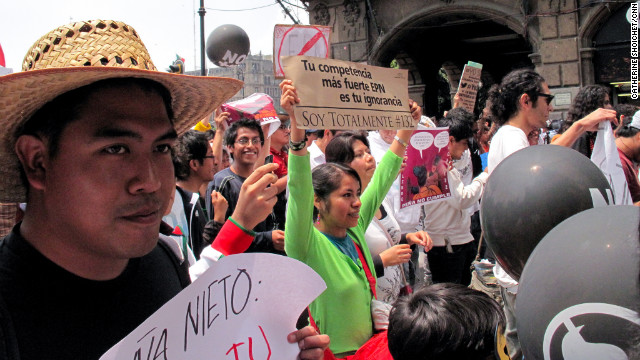
"We are ninis," one demonstrator's sign says at Sunday's protest. "We neither give up nor shut up."
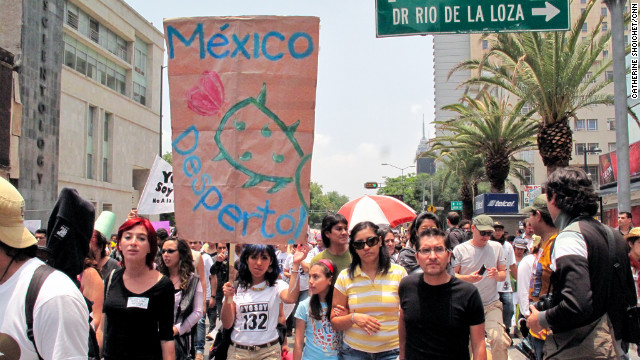
Nearby, a girl with blue streaks in her hair and braces on her teeth hoists a huge, hand-painted sign.
"Mexico woke up," it says in curvy letters surrounding an image of a flowering cactus.
The girl holding the sign, Selene Galindo Enriquez, says she woke up too after she saw the Ibero students' video online and then starting doing more research.
"I realized there were other people who think the way I do," says Enriquez, 20, who plans to vote for the first time Sunday.
Her friends tried to dissuade her from participating in the movement, telling her it was a waste to spend time with people "who make noise but don't know why." But she started coming to protest marches and other #YoSoy132 events anyway, her mother at her side.
"We'll see what happens, because who knows how many of us there are," she says. "This is the beginning of many things."
Someone shouts into a megaphone, "Let's go to Televisa," and the crowd of protesters winds down a side street toward the media giant's studios.
This time, the Ibero students opt out. There is only a week until the election and much to be done. More social media campaigns. A protest the day before the vote. Training election observers.
They pile into cars and pull away from Mexico City's main drag but minutes later cross paths with throngs of protesters, marching toward the television station to protest its coverage.
Demonstrators file across the street wielding banners that say "Turn off your television, turn on your brain" and "We are more awake than ever." Many wave signs saying "#YoSoy132."
One of the Ibero students, Federico Gomez, pounds his car horn in a show of support. The crowd cheers. He sticks his arm out the window and pumps his fist in the air as traffic cops wave him past.
Sosa sits in the passenger seat, flipping through the pages of a comic book and skimming his Twitter feed. A pop song blares through the car's speakers.
TonightWe are youngSo we'll set the world on fireWe can burn brighter Than the sun
They are on the way to a classmate's house to plan the group's next move.


Mexican election could mean drug war strategy shift, U.S. officials say

Tue June 26, 2012
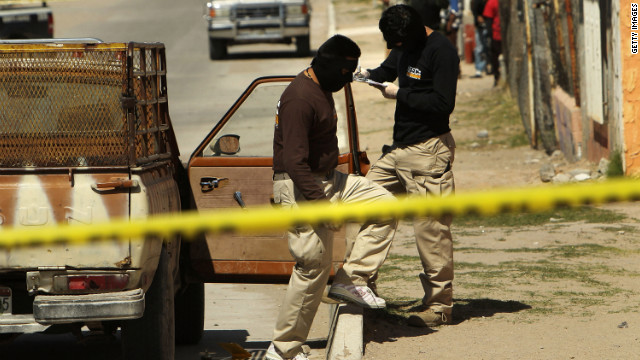
Police investigate the killing of two women in Juarez, Mexico, which has been wracked by violent drug-related crime.

STORY HIGHLIGHTS
  • Deadly drug war among top issues as Mexican presidential hopefuls suggest new strategies
  • Some U.S. lawmakers fear cross-border cooperation could wane after July 1 vote
  • What's new: Three leading candidates are committed to working with U.S., analysts say
Fighting with deep drug war wounds is a top issue on Mexico's presidential campaign trail, but the election results could have an impact on both sides of the Mexico-U.S. border.
As candidates across party lines suggest new strategies, like reducing violence and taking troops off the streets, some U.S. lawmakers say they're nervous that cross-border cooperation could wane after Mexican voters pick a new president July 1.
Last week, a Republican congressman told the head of the U.S. Drug Enforcement Administration that he was concerned about Mexico's "impending change in power."
And Sen. John McCain, R-Arizona, said in February that he feared at least one Mexican presidential candidate was not committed to continuing his country's campaign against organized crime.
Worries in Washington as Mexico's election looms are a reminder of the close ties binding the neighboring nations. The two countries share billions of dollars in trade and a border that stretches for nearly 2,000 miles. Millions of U.S. citizens travel to Mexico every year, and millions of Mexican immigrants -- legal and illegal -- live in the United States.
"Almost no other country affects the United States as much on a day to day basis as Mexico," said Shannon O'Neil, a Latin American studies fellow at the Council on Foreign Relations.
"What happens in Mexico is hugely important for the United States."
For nearly six years, a brutal drug war in Mexico with a staggering death toll of more than 47,500 people has dominated discussions between the two countries.
Announcing a crackdown on cartels and sending troops into the streets to help fight the battle were among the first major moves by President Felipe Calderon after he took office in December 2006.
The United States voiced its support and offered $1.6 billion to aid in the fight. U.S. officials have praised growing cooperation with the Mexican government as a key weapon in the war on drugs.
Democratic Revolution Party candidate Andres Manuel Lopez Obrador is pledging \
Democratic Revolution Party candidate Andres Manuel Lopez Obrador is pledging "hugs, not bullets."
But on the campaign trail in Mexico this year, the three leading candidates have stressed the need to shift strategies.
Leftist candidate Andres Manuel Lopez Obrador of the opposition Democratic Revolution Party has summed up his security policy as "abrazos, no balazos" (hugs, not bullets).
He started his campaign with a pledge to pull back troops from Mexico's streets, but he said last month that the military would remain deployed until there is a "trained, skilled and moralized" police force.
Josefina Vazquez Mota of the ruling National Action Party has apparently tried to distance herself from Calderon's policies with a simple slogan: "Josefina Diferente" (Different Josefina).
"The results will be measured not just by criminals captured, but by how stable and secure communities are," her campaign website says.
Enrique Pena Nieto of the opposition Institutional Revolutionary Party (PRI) has pledged to focus more on reducing violence and less on catching cartel leaders and blocking drugs from reaching the United States.
He told CNNMexico that federal, state and local authorities would coordinate a better security plan on his watch.
"I propose adjusting the strategy and making a national front that involves the three levels of the government, focused on diminishing the violence in the country," he said.
Josefina Vazquez Mota of the ruling National Action Party has appeared to distance herself from the incumbent\'s policies.
Josefina Vazquez Mota of the ruling National Action Party has appeared to distance herself from the incumbent's policies.
Some political opponents of Pena Nieto, whose party governed Mexico for more than 70 years until 2000, have warned that negotiating with drug cartels and gangs could be on his agenda -- an accusation that Pena Nieto has repeatedly denied.
But his denials haven't squelched speculation on both sides of the border that negotiating with cartels -- or at least easing the pressure on them -- could be on the table.
In a congressional hearing last week, U.S. Rep. Jim Sensenbrenner said the war on drugs was nearing a "potential crossroad," referring to Pena Nieto's plan and his party's political history.
"While in power, the PRI minimized violence by turning a blind eye to the cartels," the Wisconsin Republican said, noting that Pena Nieto "does not emphasize stopping drug shipments or capturing kingpins."
Minutes earlier, DEA Administrator Michele Leonhart had testified that Mexico had extradited more than 200 accused suspects to the United States since 2010.
"Without reservation, I would characterize the cooperation between United States and Mexico at an all-time high," she said.
Sensenbrenner said the close teamwork could be short-lived.
"I worry that the relationship could be at a high water mark with the impending change in power," he said.
In a statement the next day, Pena Nieto's campaign said he was committed to combatting organized crime.
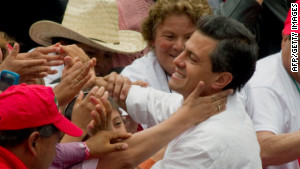
Enrique Pena Nieto of the Institutional Revolutionary Party has faced criticism from U.S. lawmakers.
"The law is applied, it is never negotiated," the statement said.
No matter who wins, the election will likely mark "a change from where U.S.-Mexico security strategy has been," said O'Neil of the Council on Foreign Relations.
But the shift is something U.S. officials who work with Mexico have prepared for, she said.
Robert Pastor, director of the Center for North American Studies at American University in Washington, said a change in presidential leadership will give Mexican officials a chance to consider fresh approaches to deal with drug-related violence and other issues that affect the United States, such as economic and energy policies.
"Between the three candidates and the predecessors, there would be an opportunity to reflect on what worked, and what didn't work, and how, perhaps things should be changed," he said.
The concerns from some U.S. lawmakers about a shift in drug war strategy are overblown, he said.
"All three of the major candidates have committed themselves to fighting drug trafficking and reducing the violence," Pastor said. "All three are very much committed to working with the United States."
That itself is a notable shift from past elections, when cross-border relations soured or sweetened based on who won the presidential vote, according to Andrew Selee, director of the Mexico Institute at the Woodrow Wilson International Center for Scholars.
"The U.S.-Mexico relationship has now matured to a point where changes in party and personality matter less than they used to," he said.
"This is a country that matters enormously for the U.S., and for the first time, perhaps, what happens in the elections won't change [that relationship] much."


FICHAJES DE LA EUROCOPA 2012: El club Barcelona, donde milita el delantero chileno Alexis Sánchez, acordó con el Valencia el traspaso del seleccionado español Jordi Alba, quien es una de las figuras del combinado hispano


Barcelona sumará a sus filas a joven seleccionado español

El club catalán sumó al carrilero izquierdo Jordi Alba, figura de España en la Eurocopa.

por La Tercera - 27/06/2012 - 12:04
El club Barcelona, donde milita el delantero chileno Alexis Sánchez, acordó con el Valencia el traspaso del seleccionado español Jordi Alba, quien es una de las figuras del combinado hispano en la Eurocopa.
Según la prensa española, el acuerdo entre clubes está listo y solo falta que acuerden la fecha de oficialización. El diario AS dice que el costo del traspaso es de 12 millones de euros, más otros 3 por objetivos.
Alba fue formado en Barcelona pero partió joven a Valencia, club en el que se valorizó y logró integrar la selección española.
El contrato del carrilero izquierdo será por cuatro años

ELLIOT LAKE MALL TRAGEDY: One body has been recovered from the debris at Algo Centre Mall, officials confirmed at 9:40 on Wednesday morning


ELLIOT LAKE, ONT.—One body has been recovered from the debris at Algo Centre Mall, officials confirmed at 9:40 on Wednesday morning.
“We have spoken to the families of the person,” said Dan Hefkey, commissioner for community safety for Ontario. He did not release a name, age or gender but said the body was found in the area near the escalator.
The body, covered with a white cloth, was carried out on a stretcher passed a line of rescue workers who took off their hard hats as it went by.
Hefkey said rescue crews have returned to the rubble of the mall to search for others.
“They are back in there and making a determination,” said Hefkey when asked if the crews were on a rescue or a recovery mission. “The canine units were also in.”
“We found one, the assumption is that there is more than one.”
Is there any hope people will be found alive? “Yes, always,” he said.

PHOTOS on the Web: Click here for a photo gallery of the scene of the collapse.

A dozen people are unaccounted for.
“They will continue to search that whole area until they are absolutely certain there is no one left.”
OPP Commissioner Chris Lewis promised a full investigation into incident.
“There was never any intention of the HUSAR (Heavy Urban Search and Rescue) team to leave the area without completing the job,” he said to criticism of a stalled rescue since the roof collapse Saturday afternoon.
Despite the concerted effort, he said, “sometimes the best just isn’t good enough.”
While there were “no signs of life,” Lewis said, that didn’t mean all hope was lost.
The search operation is now concentrated on a 10-by-25-metre area after earlier efforts swept the rest of the mall and determined no one was in there, he said.
At least one more person is confirmed to be trapped.
Standing next to Hefkey, Rick Hamilton spoke, his eyes heavy with tears.
“Please allow us to mourn,” said Hamilton. “It is a deep, deep tragedy.”
As the two spoke, locals pressed against the barricade struggling to pick up their words. Their faces strained masks, holding back tears. More than 200 stood in the steady rain.
Gary Gendron, whose fiancee Lucie Aylwin is one of the two people confirmed to be trapped under the rubble, went inside a local business to talk to an OPP officer at about 9 a.m. He has not been seen since.
Crews had worked through the night to clear debris as family and friends kept a vigil outside more than three days after the mall roof fell in on a busy afternoon shopping crowd.
Hefkey said the cranes managed to move an escalator and flight of stairs overnight that had been a big hindrance in the search and rescue. “It was hanging there by its side,” he said. “They pulled it toward them, toward the exit.”

MORE on the Internet: Concrete expert says salt seepage could have weakened Elliot Lake mall roof

Three cranes by dawn had cleared the 10-by-25-metre area, described as a “bubble,” in the first step in the search for those who are still trapped under debris after the mall roof collapsed Saturday afternoon.

MORE on the Internet: DiManno: Amid disaster in Elliot Lake, an inexcusable lack of action

Early Tuesday, Bill Neadles, spokesman for the Heavy Urban Search and Rescue operations, said that someone trapped in the debris would have “a very slim ability for that person to live.”
Nonetheless, Hefkey is not calling the mission a recovery mission, but neither will he confirm it is a rescue mission.
“At this point, because of the time that has passed, the focus of our mission is to be the least destructive and safest for workers and victims,” said Hefkey.
Residents weren’t optimistic.
“It’s never been a rescue mission. They know it and I know it,” said Dave Maclellan. “But it’s the only way people are going to get closure.”
Despite the chaotic appearance of the rescue effort at times, the machines were operating with “surgical precision,” Hefkey said.
They managed to complete all work throughout the night without sending any debris into a designated area towards the back, he said.
Hundreds of residents of this small town showed up to watch the demolition,
Armed with coffees, wearing jackets and carrying folding chairs and blankets, people started arriving at the site around 9 p.m. just as the giant robotic arm began tearing apart a part of the mall.
There were loud cheers and claps as the first bit of concrete and railing was torn from the crumbling building, sending a plume of dust-smoke in the air. Slowly, windows were smashed, part of the roof plucked out completely.
MORE on the Internet: Elliot Lake residents vows to stick together

Shortly after midnight, a large I-beam fell in the area being worked on, setting off gasps from the crowd.
“Certainly everybody is optimistic about what’s happening here. When that big piece fell, people were hoping it didn’t fall in the middle and jeopardize any possible miracle,” said local MP Carol Hughes.
To a question how the search and rescue teams who worked through the night were holding up, Hefkey said they want “to bring this to a successful conclusion.”
Hefkey didn’t specify when but said that structural engineers will work with the ministry of labour to determine what happened at the mall on Saturday afternoon.
Top Stories:

‘Ovenlike’ conditions on their way to Southern Ontario

Tim Hudak urges sweeping changes to strip unions of power, help business create jobs

Hand over your tips or else, posh Muskoka hotel warns staff

Police arrest suspect after woman shot at Scarborough home